
Somewhere Between Wu-Tang and a Cinnamon Tree
Marty O’Reilly tells a story about falling down a rabbit hole on Napster.
He was looking for Wu-Tang Clan—as one does—and instead stumbled onto a recording from the 1920s by Blind Willie Johnson.
That accident—hip hop to pre-war gospel blues in a single click—feels like as good an origin story as any for what unfolded this past weekend in Reno. Because nothing about Marty O’Reilly is linear. Not his influences, not his songs, and certainly not his performances.
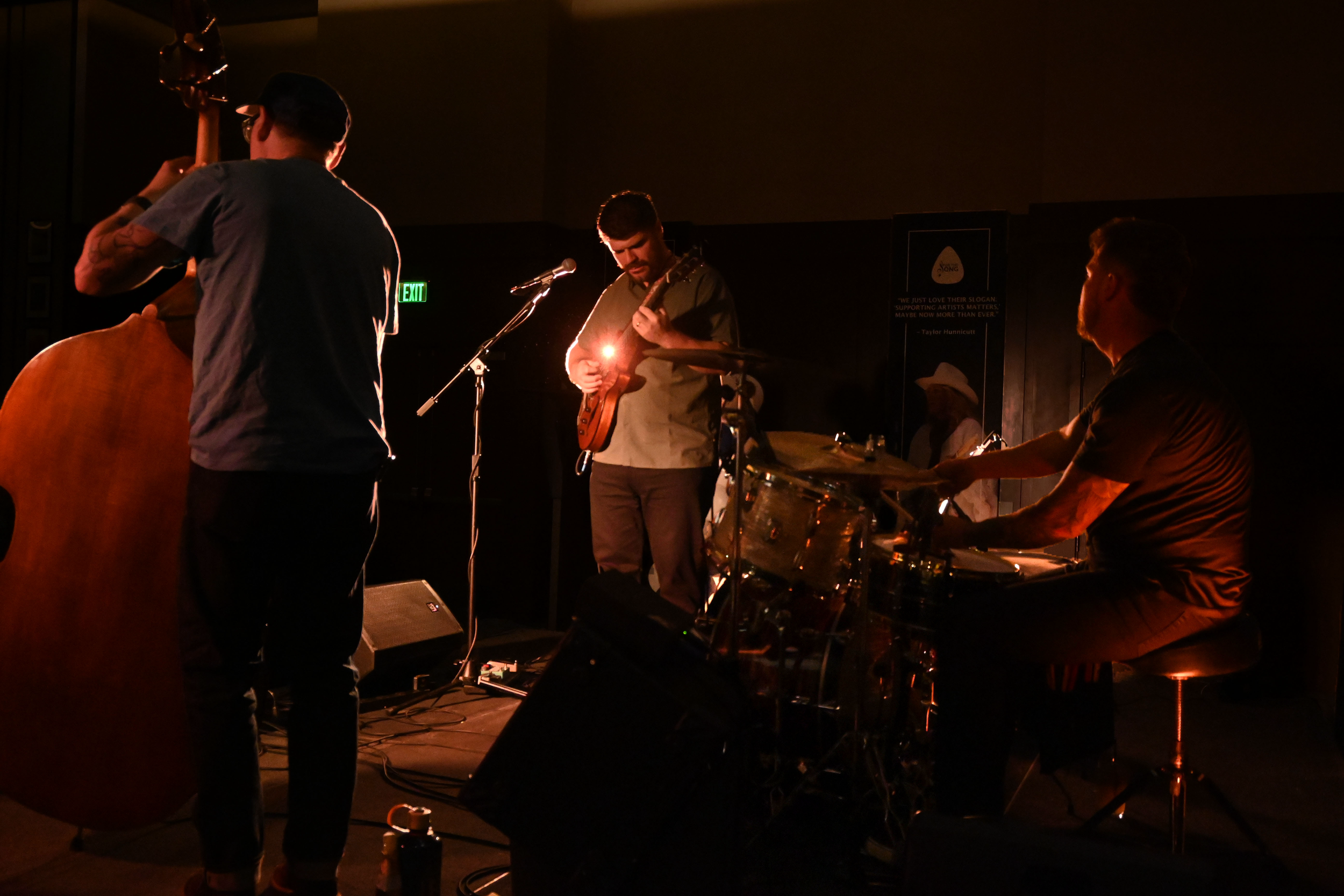
Marty O’Reilly On Stage at ArrowCreek — Click to See the Video Diary
Two Nights, One Thread
On Friday night at Reno Public Market, he played in what might be one of the more difficult environments for live music: a food hall, where nearly half the room didn’t come for the show.
Conversations, dinner, drinks, movement—everything working against attention.
And yet, slowly and then all at once, he gathered the room. People turned their chairs. Conversations softened. Libations paused mid-air. By the end, he had them—leaning in.
It was, by any measure, one of the most successful public shows we’ve impacted through For the Song. A free performance that resulted in over $550 in “streaming-effected intellectual property stipends,” not just tips, heading to the artist. Proof that audiences WANT to support superb musicians against a music business model severely impacted by streaming.
Saturday night at The Club at ArrowCreek offered a different kind of challenge. Not noise, exactly—but expectation. A private setting brings with it a mix of intentions. Some arrive ready to listen deeply. Others arrive ready to socialize. And sometimes those impulses overlap in ways that are… imperfect.
It’s the oldest tension in live music: where does conversation end and listening begin? And like most things worth doing, it’s not something that ever gets solved—only navigated.
Songs Discovered, Not Written
In Marty’s ‘Cinnamon Tree,’ a three-legged dog becomes something more than a character—it becomes a reminder that what we hold onto isn’t the shape of a thing, but the spirit that made us love it in the first place.
It’s “so Marty” that he’s never known a 3-legged dog. He wrote it, he said, because he liked the rhythm of the phrase.
Not the meaning—the feel. And that tells us almost everything we need to know. Marty O’Reilly doesn’t start with what something means. He starts with how it feels—and trusts meaning to follow.
He is, by his own description, obsessed with stripping away artifice—believing that what remains, when everything unnecessary is removed, is the truth of the artist.
And more importantly, a truth that audiences can recognize.
His Instrument Has a Past
That philosophy extends beyond the songs. It lives in his instrument.
Marty plays a restored resonator guitar made from Nicaraguan rosewood—an instrument that, like the music he draws from, carries its own layered history. It doesn’t sound polished. It sounds lived in. Weathered. Earned.
You don’t just hear it—you feel where it’s been. And in his hands, it becomes part of the conversation.
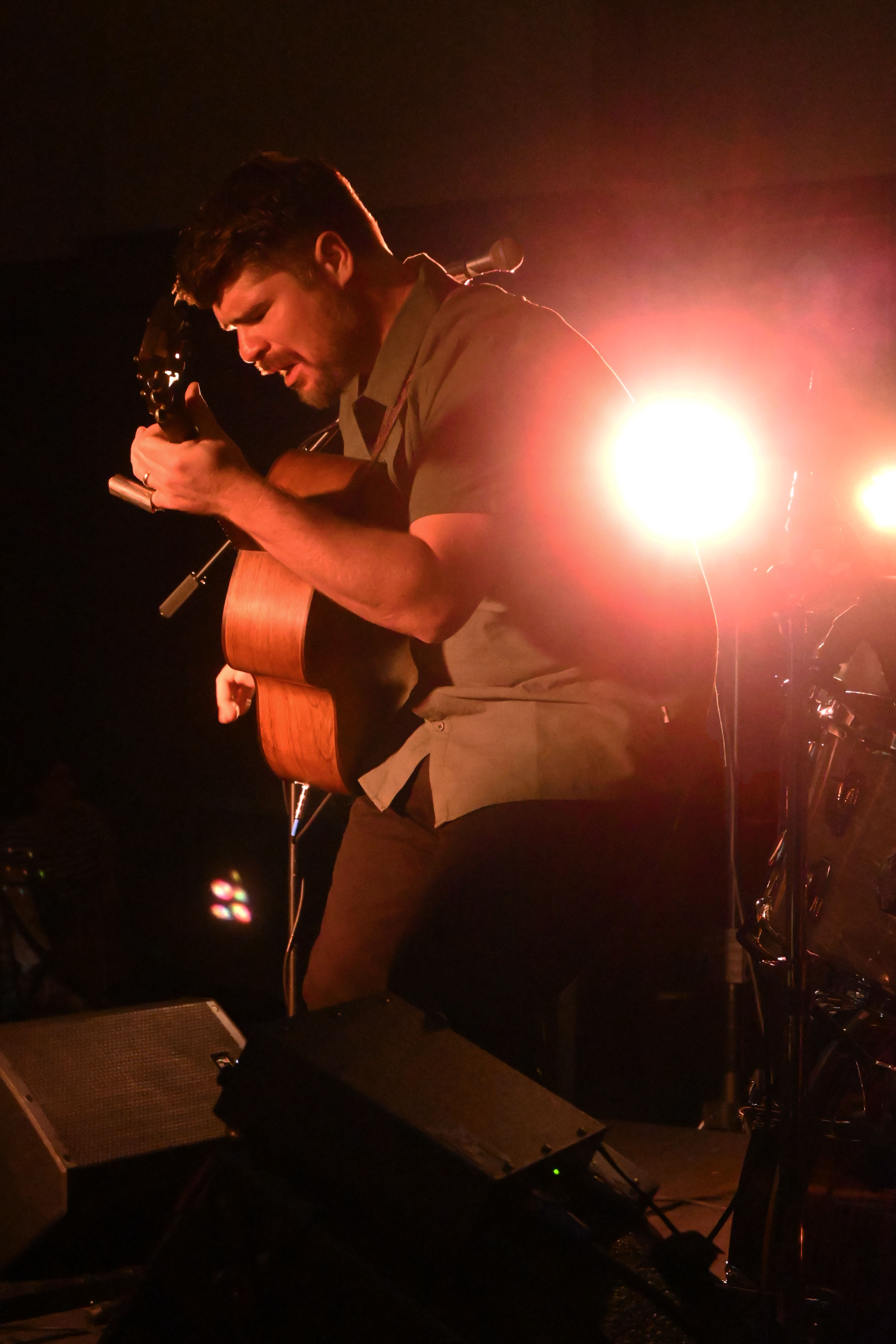
When the Room Finds Its Way
What’s most remarkable is how his performances may begin in very different places—yet often end in the same one.
A public market filled with ambient noise. A private club filled with overlapping expectations. Two completely different starting points. And yet, by the middle of each set, something shifts.
Not perfectly. Not uniformly. But noticeably. He removes just enough distance that there’s no clear boundary left at all. He has said that connection happens when you don’t hold back. When you allow something real to come through, unprotected.
And when that happens, people respond.
At ArrowCreek, more than 93% of those in attendance chose to donate, another record—with every dollar going directly to the artist—pushing the weekend beyond his guarantee.
Which confirms something important:
Even in imperfect spaces, generosity finds its way forward.
A Funeral Procession, Reimagined
And then there’s the ending. At both shows, as he often does, Marty stepped off the stage, unplugged, and into the audience.
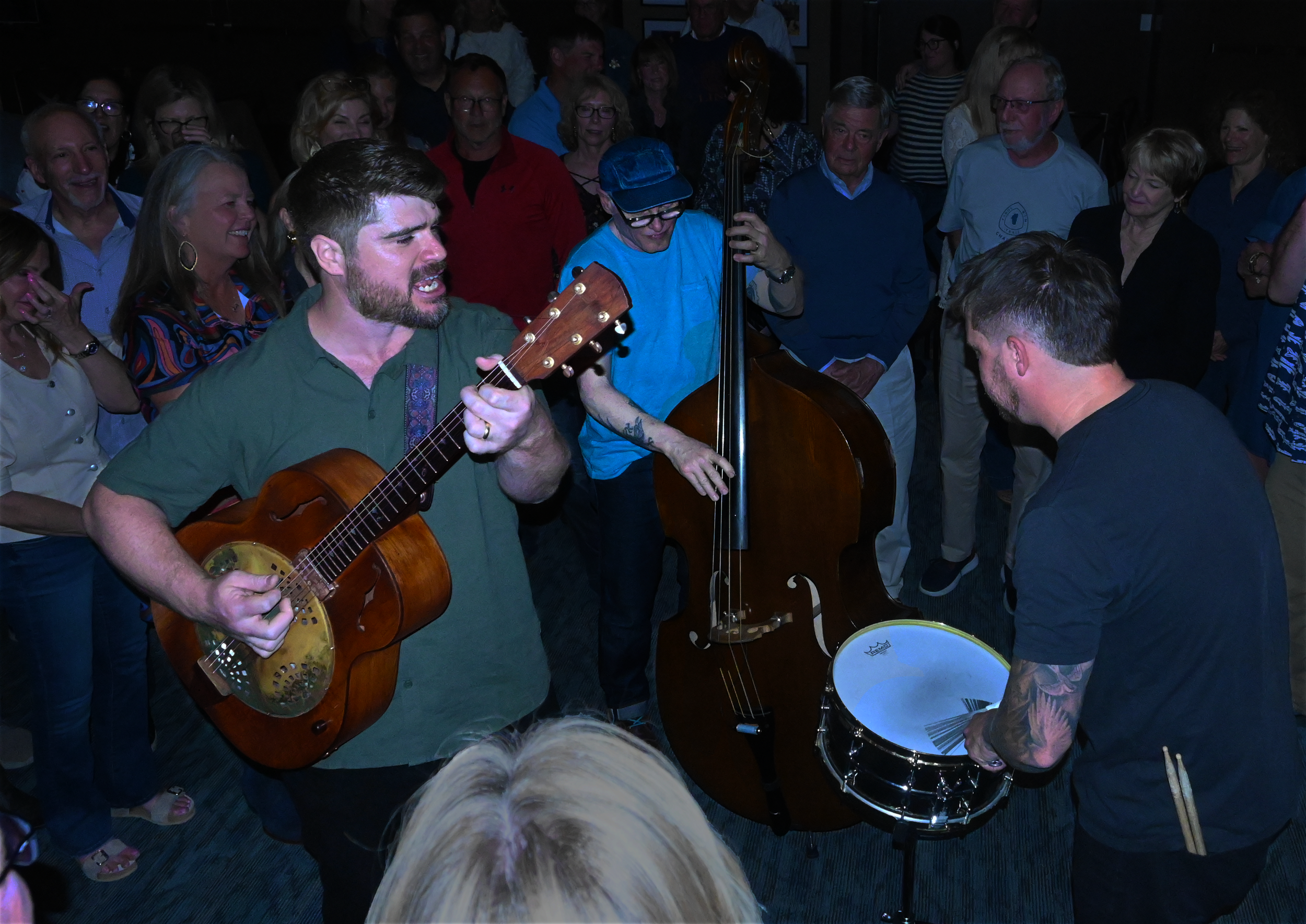
More than a hundred people gathered close as he told the story of a night in Europe. A strange promoter frustrating performers with a request to hastily assemble a group called the “California AllStars”—a name Marty still shakes his head at.
They couldn’t agree on what to play.
So Marty chose something else entirely -- a funeral procession.
What followed was a slow march out of the theater and into the streets, the band playing as the crowd snaked behind them through town. At the center of it all: that same resonator guitar, carrying a song older than any of them.
From that experience came his relationship with St. James Infirmary—a song that, in his telling, somehow holds both grief and something like joy, a buoyancy. Standing there at ArrowCreek, surrounded by listeners who had each arrived with their own expectations, he recreated a version of that moment. Not by weaving out of the room—but by inviting it to move together.
Closing Time
He closed, as he often does, with something unexpected -- a singalong.
“If you don’t know the words to this song,” he said, “what is wrong with you?” And just like that, more than a hundred voices joined in on Otis Redding’s classic—(“Sittin' On) The Dock of the Bay.”
Every word. Every line.
The same crowd that had, at times, been navigating how best to share the space now found itself in complete alignment—singing together, loud, unguarded, and entirely present.
And when it ended, they didn’t just leave. They drifted out the way that European crowd once did—together, a little changed, carrying something with them.
So maybe what people are responding to isn’t perfection, but participation.
Each time, a little more trust. A little more generosity. A little more willingness to meet the moment—even when it’s not perfectly defined.
Somewhere between Wu-Tang and Blind Willie Johnson…. Between a three-legged dog that never existed and a guitar that has already lived a lifetime…
Something real happened. And for a moment—however imperfectly everyone arrived there—the room found it together.